Blog
What Is the Surface Area of a Hemisphere?
Hemisphere surface area measures how much outer shell a half-sphere covers, including the curved cap and optionally the flat circular base.

Blog
Hemisphere surface area measures how much outer shell a half-sphere covers, including the curved cap and optionally the flat circular base.
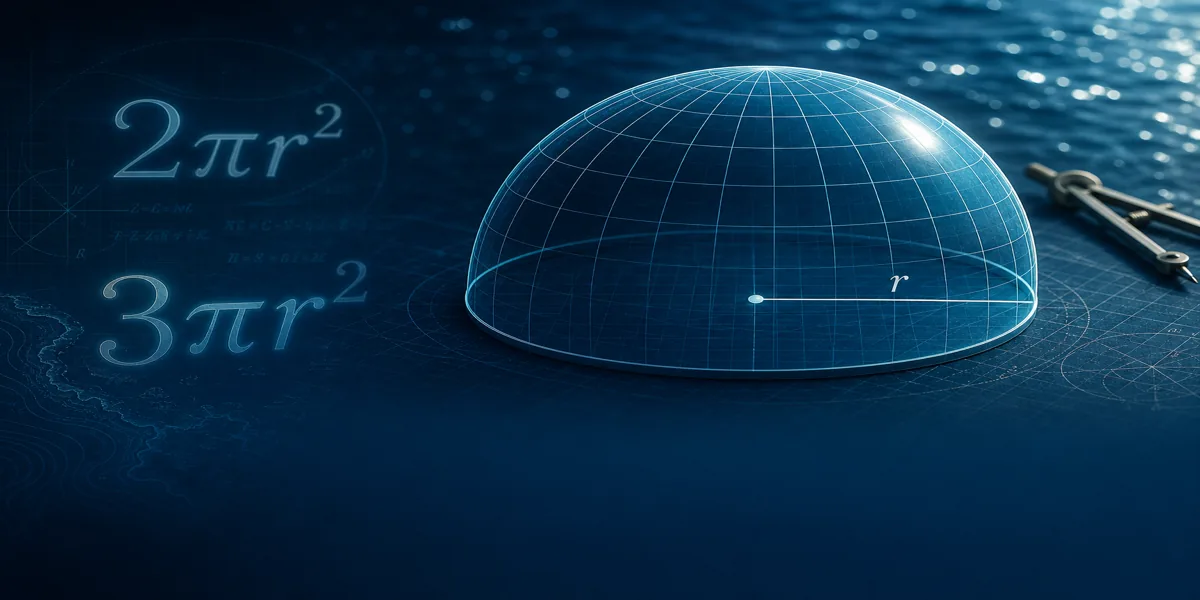
Hemisphere surface area is the area on the outside of a half-sphere. Curved surface area is 2πr². Total surface area, including the flat base, is 3πr².
Formula
Surface Area of a Hemisphere Calculator gives you curved and total surface area from a single measurement, but the numbers only help after you know what is being measured.
This guide defines hemisphere surface area for geometry class, engineering layouts, architecture, and manufacturing specs where domes and tank heads appear daily.
You will see two common totals in textbooks: curved surface area (the dome only) and total surface area (dome plus base). Keeping those separate prevents the most common homework mistakes.
A hemisphere is formed when a sphere is sliced by a plane through its center. The curved cap is the part that remains from the original spherical surface. The base is the flat circular face created by the cut.
Surface area is not volume and not edge length. It is the sum of areas you could cover on the exterior, reported in square units such as m², ft², or cm².
In dome design, you may need only the curved shell for cladding or insulation. In a solid model with a visible base, the total exterior often includes that circle. Picking total surface area when the prompt asked for curved only is the usual mistake.
Before you substitute numbers, read the hemisphere surface area formulas so you know which expression matches your diagram.
Radius r is the distance from the center of the original sphere to the surface. Every surface formula on this site is written in terms of r, even when real drawings list diameter instead.
The curved cap is exactly half of a full sphere surface (4πr²), which is why CSA uses 2πr². The base is a circle with area πr².
When a problem asks you to "find the surface area of a hemisphere" without more detail, check your textbook or instructor notes. Many courses mean total surface area, but some specify lateral or curved area only.
After you identify the correct type, follow the step-by-step calculation method to measure radius, apply the formula, and label units.
Suppose a display dome has radius 5 m. Curved surface area = 2π(5)² = 50π ≈ 157.08 m².
If the flat base is also finished on the outside, total surface area = 3π(5)² = 75π ≈ 235.62 m².
The base alone would be π(5)² = 25π ≈ 78.54 m². Notice TSA is not double CSA; it is CSA plus one circular base.
Hemisphere surface area splits into a curved cap and an optional flat base. Read the problem, choose CSA or TSA, then measure radius carefully.
Use the home calculator to confirm hand work, and continue with formula and how-to guides when you need more detail.
Hemisphere volume (2/3)πr³ and surface area formulas together: dimensional analysis, surface-to-volume ratio, examples, and how the calculator links both.
Calculate hemisphere surface area from diameter: convert to radius, use CSA and TSA formulas, worked examples, and field measurement accuracy tips.
Compare hemisphere and sphere surface area and volume: 4πr² vs 2πr² and 3πr², key differences, side-by-side examples, and common misconceptions.