Blog
Total Surface Area of a Hemisphere
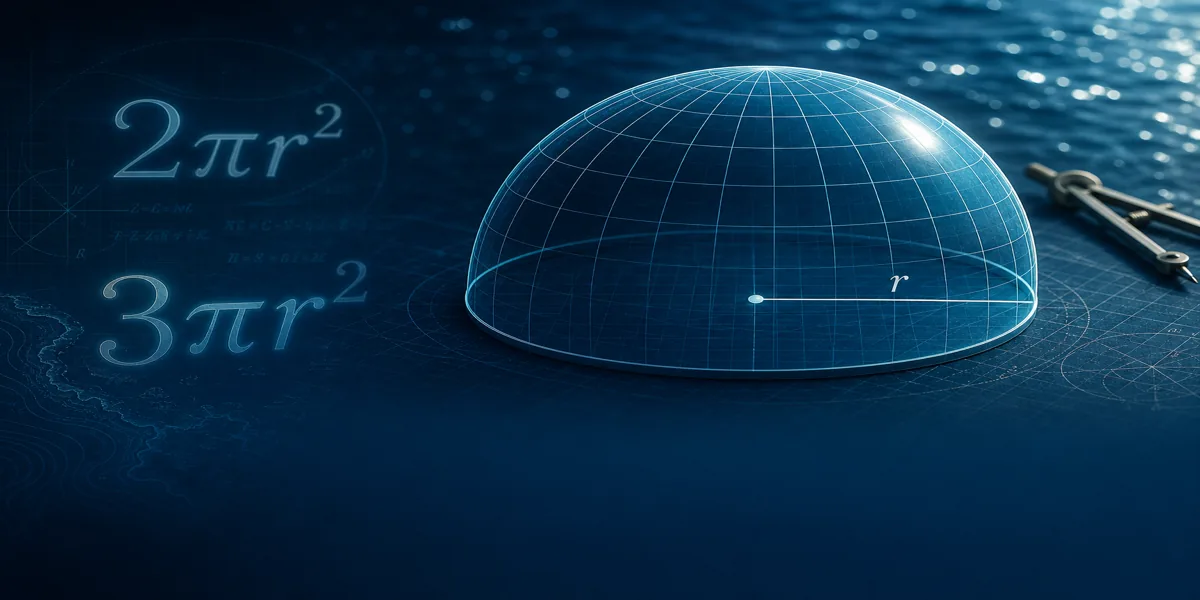
Total surface area counts the curved cap and the flat circular base together.

Blog
Total surface area counts the curved cap and the flat circular base together.
TSA = 3πr² = 2πr² + πr².
Formula
Surface Area of a Hemisphere Calculator shows total surface area as 3πr² next to curved and base fields.
Use this total when a solid hemisphere model or finished part exposes both the dome and the flat face.
Students confuse TSA with CSA when problems use the short phrase "surface area" without a qualifier.
A machined hemisphere that ships as a complete exterior part may need paint or coating on both cap and base.
Math models of solid hemispheres on tabletops usually count TSA because the base is visible.
Tank head problems vary: some include only the curved metal, while others add the flange face. Read the diagram notes.
See hemisphere surface area examples for side-by-side CSA and TSA numbers at several radii.
Total surface area is the sum of the curved cap and the base circle. The base contributes exactly πr².
For any radius, TSA exceeds CSA by πr². That difference is stable and easy to check on a calculator.
If you only need the dome portion, read curved surface area of a hemisphere instead of using 3πr².
r = 3 units: CSA = 18π ≈ 56.55. Base = 9π ≈ 28.27. TSA = 27π ≈ 84.82.
r = 10 m: TSA = 300π ≈ 942.48 m² for a large cap with a coated base ring.
Check: TSA minus CSA should always equal πr² for the same radius.
Add the base when the full outside of the shape is required. TSA = 3πr² captures both parts in one line.
Hemisphere volume (2/3)πr³ and surface area formulas together: dimensional analysis, surface-to-volume ratio, examples, and how the calculator links both.
Calculate hemisphere surface area from diameter: convert to radius, use CSA and TSA formulas, worked examples, and field measurement accuracy tips.
Compare hemisphere and sphere surface area and volume: 4πr² vs 2πr² and 3πr², key differences, side-by-side examples, and common misconceptions.